




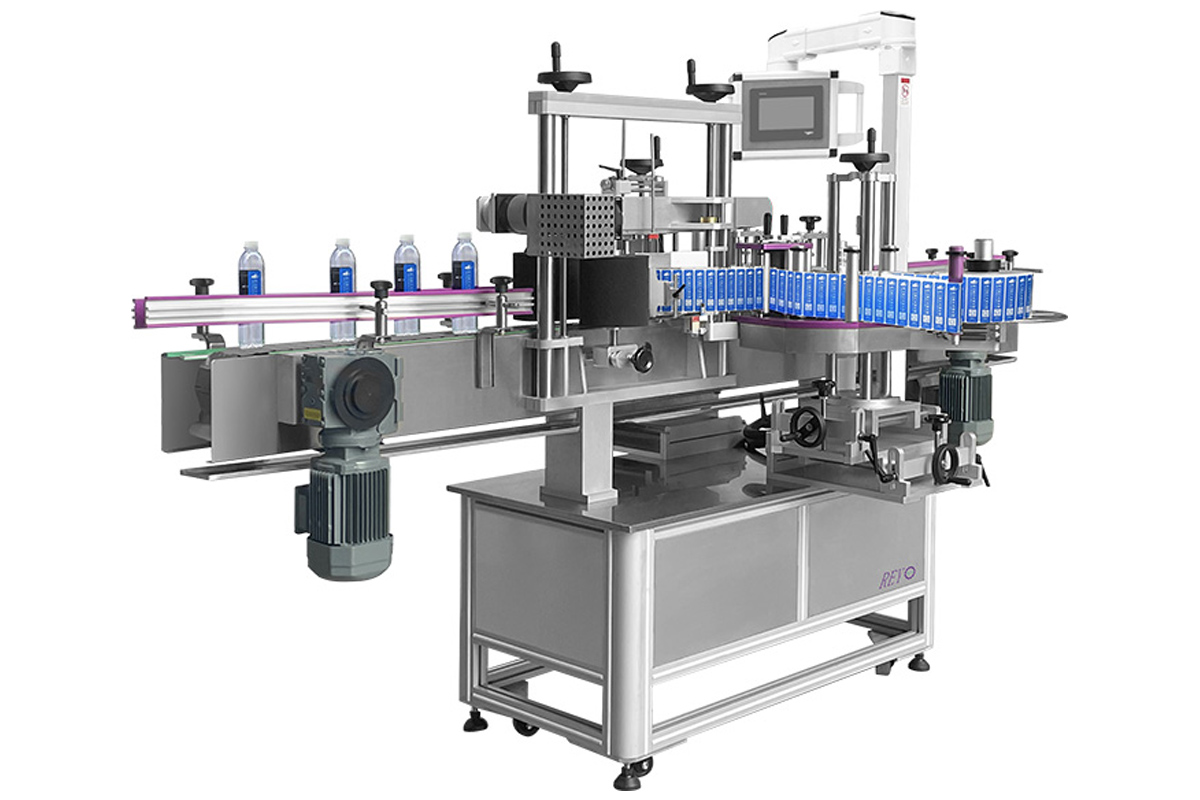
Automatic Double Sides Labeling Machine: Working Principles, Adjustment, and Maintenance
An Automatic double sides labeling machine is designed to apply labels to both sides of bottles or containers in a single production process. It is widely used in food and beverage, pharmaceutical, cosmetics, household chemicals, and other manufacturing industries where accurate and consistent product labeling is essential.
As an important type of automatic labeling machine, a double sides labeling machine can improve production efficiency, reduce manual labor, and maintain consistent label placement. However, achieving reliable labeling performance depends not only on the machine's design but also on correct adjustment, regular maintenance, and proper operation.
Understanding how labeling equipment works and how to troubleshoot common problems helps manufacturers maintain stable production and extend the service life of their equipment.

How Does an Automatic Double Sides Labeling Machine Work?
An Automatic Bottle Labeling Machine typically integrates bottle feeding, container positioning, label dispensing, label application, and bottle discharge into one production line.
First, containers enter the machine through a conveyor system. The bottle positioning and guiding mechanisms keep them properly aligned as they move through the labeling station. Sensors detect the presence or position of each container and trigger the label dispensing system.
For a double side labeling machine, labels are applied to the front and back surfaces of a container. Depending on the machine configuration, the labeling heads can be adjusted to accommodate different bottle widths, heights, and shapes. Brushes, rollers, or other pressing mechanisms then help labels adhere smoothly to the container surface.
A high speed labeling machine coordinates the conveyor, sensors, and labeling heads to maintain consistent operation. When properly configured, a fully automatic labeling machine can reduce manual intervention while supporting continuous production.
Key Applications of a Double Sides Labeling Machine
A double sides labeling machine is suitable for containers that require labels on two opposing surfaces. Its applications depend on the container shape, label dimensions, adhesive type, and machine configuration.
Flat and square bottles
Flat bottles can be labeled on the front and back panels, while square containers may require additional positioning adjustments to ensure that labels remain aligned with the intended surfaces.
Round bottles
A bottle labeling machine can apply front-and-back labels to round containers when the machine is equipped with the appropriate positioning and labeling mechanisms. For applications requiring labels around the entire circumference, a dedicated wrap-around labeling configuration may be more suitable.
Containers requiring multi-side labeling
A multi-side labeling machine can be configured for additional labeling positions, such as three-sided or other multi-panel applications. The appropriate setup depends on the container geometry and the required label layout.
For manufacturers handling multiple product sizes, adjustable guides, labeling heads, and sensors are important considerations when selecting industrial labeling equipment.
Essential Adjustments for Stable Labeling Performance
Correct mechanical adjustment is essential for maintaining labeling accuracy. The following areas deserve particular attention during installation, commissioning, and routine troubleshooting.
1. Adjusting the Label Pressing Brush
The pressing brush helps smooth the label against the container surface and reduce wrinkles or incomplete adhesion.
The center of the brush should align with the label, with both sides positioned symmetrically. The brush should remain perpendicular to the container surface to ensure even contact.
For traditional brush-based labeling mechanisms, the overlapping sweep distance is typically adjusted according to the machine structure. A single brush may require an overlap of approximately 10–15 mm, while a combined brush arrangement may use approximately 5–10 mm. The cleaning brush should also maintain an appropriate clearance from the sponge or other contact component.
The bottle pressing head must be adjusted according to the machine's operating procedure so that containers are held securely without excessive pressure. Incorrect adjustment may cause unstable positioning, bottle damage, or inconsistent label placement.
These dimensions are reference values for applicable machine designs. Always follow the equipment manufacturer's specifications.
2. Adjusting the Label Magazine and Feeding Mechanism
The label magazine guides labels toward the dispensing mechanism. Incorrect clearance or alignment can cause skewed labels, feeding resistance, or inconsistent label pickup.
The label magazine centerline, labeling station centerline, and label plate centerline should be aligned according to the machine design. The label plate and label feeding surface should also be positioned correctly to support smooth label transfer.
For traditional label magazines, the clearance between the label stack and the side retaining strips may be approximately 0.8–1.0 mm, depending on label thickness and equipment structure. Excessive clearance can allow labels to shift, while insufficient clearance may prevent smooth feeding.
The label-gripping hooks should apply balanced force across the label stack. The label pressure plate and feeding rollers must also be adjusted to hold labels securely without crushing, bending, or obstructing them.
On an automatic labeling machine, stable label feeding is essential for maintaining consistent output and minimizing production interruptions.
3. Adjusting the Bottle Infeed and Discharge Systems
The infeed star wheel, discharge star wheel, and bottle infeed screw help transfer containers through the labeling station in a controlled sequence.
During adjustment, the bottle positioning mechanism should be used as the reference point. The infeed star wheel should place each bottle centrally within its corresponding recess when the container reaches the intended positioning point.
The infeed screw should then be adjusted to guide the bottle toward the star wheel without pushing it out of position. Similarly, the discharge star wheel should be aligned so that each container remains centered in its recess as it leaves the labeling station.
Incorrect synchronization between these components can lead to bottle collisions, unstable feeding, labeling errors, or production stoppages.
For a high speed labeling machine, accurate coordination between the conveyor, infeed screw, star wheels, and labeling mechanism is particularly important.
4. Adjusting the Labeling Station
For traditional glue-based labeling equipment, the scraper plate, glue roller, and label plate must work together to distribute adhesive evenly.
The scraper plate should maintain consistent contact with the glue roller along its working length. If an uneven gap develops, the scraper plate may need adjustment according to the machine's design.
The glue roller and label plate should make appropriate contact without excessive pressure. Too much clearance can result in excessive adhesive application and glue splashing, while excessive pressure may remove too much adhesive and cause uneven coverage.
For some traditional glue-labeling systems, a gap or contact adjustment of approximately 0.1–0.2 mm may be appropriate. This value should not be applied universally; the correct setting depends on the roller design, adhesive properties, and manufacturer's recommendations.
These adjustments primarily apply to glue-based labeling stations. A pressure-sensitive double sides labeling machine uses self-adhesive labels and generally requires different adjustments for label dispensing, pressing rollers, and label application.
Common Labeling Problems and Troubleshooting
Even well-designed industrial labeling equipment may experience labeling problems if its components are incorrectly adjusted, worn, or poorly maintained.
| Common problem | Possible cause | Recommended action |
|---|---|---|
| Labels are skewed | Label magazine misalignment, excessive clearance, or unstable bottle positioning | Check label guides, magazine alignment, and container positioning |
| Labels wrinkle or form bubbles | Uneven pressing, incorrect brush position, or inconsistent container movement | Adjust the pressing mechanism and verify bottle stability |
| Labels are not fed smoothly | Label stack is too tight, gripping hooks are uneven, or feed rollers are incorrectly adjusted | Check label clearance, gripping force, and feeding components |
| Labels do not adhere properly | Incorrect adhesive application, contaminated surfaces, or insufficient pressing | Inspect the adhesive system or pressure-sensitive label application mechanism |
| Bottles collide or become unstable | Incorrect star wheel or infeed screw adjustment | Recheck component alignment and synchronization |
| Label position varies between bottles | Sensor misalignment, inconsistent container spacing, or unstable feeding | Inspect sensors, guides, and conveyor synchronization |
When troubleshooting, operators should identify the underlying cause before changing multiple settings. Adjusting one component at a time makes it easier to determine which change resolves the problem.
How to Extend the Service Life of a Fully Automatic Labeling Machine
Regular maintenance helps keep a fully automatic labeling machine operating reliably and reduces the risk of unexpected downtime.
Clean the machine regularly. Remove adhesive residue, paper scraps, dust, and product contamination from label guides, rollers, sensors, and contact surfaces. Use cleaning products compatible with the machine materials and the adhesive system.
Inspect mechanical components. Check brushes, rollers, belts, bearings, star wheels, and bottle guides for wear or looseness. Replace damaged components before they affect labeling quality.
Verify sensor operation. Bottle detection and label detection sensors must remain clean, securely mounted, and correctly positioned. Sensor misalignment can cause missed labels, incorrect triggering, or inconsistent spacing.
Check label feeding and tension. Ensure that label rolls are installed correctly and that the dispensing mechanism maintains suitable tension. Incorrect tension can cause label breaks, wrinkles, or unstable dispensing.
Follow lubrication requirements. Lubricate designated components according to the manufacturer's maintenance schedule. Avoid applying lubricant to label-contact surfaces or other areas where contamination could affect adhesion.
Train operators in proper adjustment. Operators should understand the machine's normal operating conditions, adjustment points, safety procedures, and troubleshooting process. Before maintenance or mechanical adjustment, follow the equipment's shutdown and energy-isolation procedures.
How to Choose the Right Automatic Bottle Labeling Machine
Selecting the right automatic bottle labeling machine requires more than comparing operating speeds. Manufacturers should consider the actual product and production requirements.
Container shape and dimensions: Confirm compatibility with flat, square, round, oval, or other container designs.
Label placement: Determine whether the application requires front-and-back labeling, single-side labeling, wrap-around labeling, or multiple label positions.
Label specifications: Check label material, dimensions, roll direction, adhesive type, and required placement accuracy.
Production speed: Match the machine's rated performance to the required production output and the capabilities of upstream and downstream equipment.
Adjustment flexibility: Consider whether the machine can accommodate different container sizes and label formats with manageable changeover time.
Automation and integration: Evaluate sensor functions, control systems, fault alarms, and compatibility with existing filling, capping, and packaging lines.
Maintenance and technical support: Review the availability of spare parts, operating instructions, commissioning assistance, and after-sales service.
An experienced labeling machine manufacturer can help assess these requirements and recommend a suitable machine configuration for the intended production environment.
Frequently Asked Questions
What is a double sides labeling machine used for?
A double sides labeling machine applies labels to two sides of a container, commonly flat bottles, square bottles, and compatible round containers. It is widely used in food, beverage, pharmaceutical, cosmetics, and chemical packaging.
What is the difference between a double side labeling machine and a multi-side labeling machine?
A double side labeling machine is designed primarily for labeling two surfaces. A multi-side labeling machine can support three or more labeling positions when configured for the required container shape and label layout.
Can a fully automatic labeling machine handle different bottle sizes?
Many machines offer adjustable guides, labeling heads, sensors, and other positioning components. However, the available size range and changeover process depend on the model. Confirm the bottle dimensions and required labeling format with the manufacturer before purchasing.
Why do labels become skewed during production?
Common causes include incorrect label magazine alignment, unsuitable label clearance, unstable bottle positioning, or inconsistent label feeding. Checking these components systematically can help identify and correct the problem.
How often should industrial labeling equipment be maintained?
Maintenance frequency depends on operating hours, production conditions, adhesive type, and the manufacturer's recommendations. Daily cleaning and routine inspections are useful starting points, supplemented by scheduled checks of wear parts, sensors, drive components, and lubrication points
An Automatic Double Sides Labeling Machine can improve labeling efficiency and consistency when it is correctly selected, adjusted, and maintained. Understanding the working principles of the labeling station, label feeding system, bottle positioning components, and pressing mechanisms helps operators troubleshoot problems and maintain stable production.
For manufacturers looking for reliable industrial labeling equipment, choosing a machine that matches the container shape, label requirements, production speed, and maintenance needs is essential for long-term performance.